
How to Build Sea Fishing Rigs: A Complete Guide for Irish Anglers
Step-by-step builds for the flapper, pulley, running ledger, pennel and float rigs, plus the kit, knots, hook sizes and shock leader rules you need for Irish shore fishing.
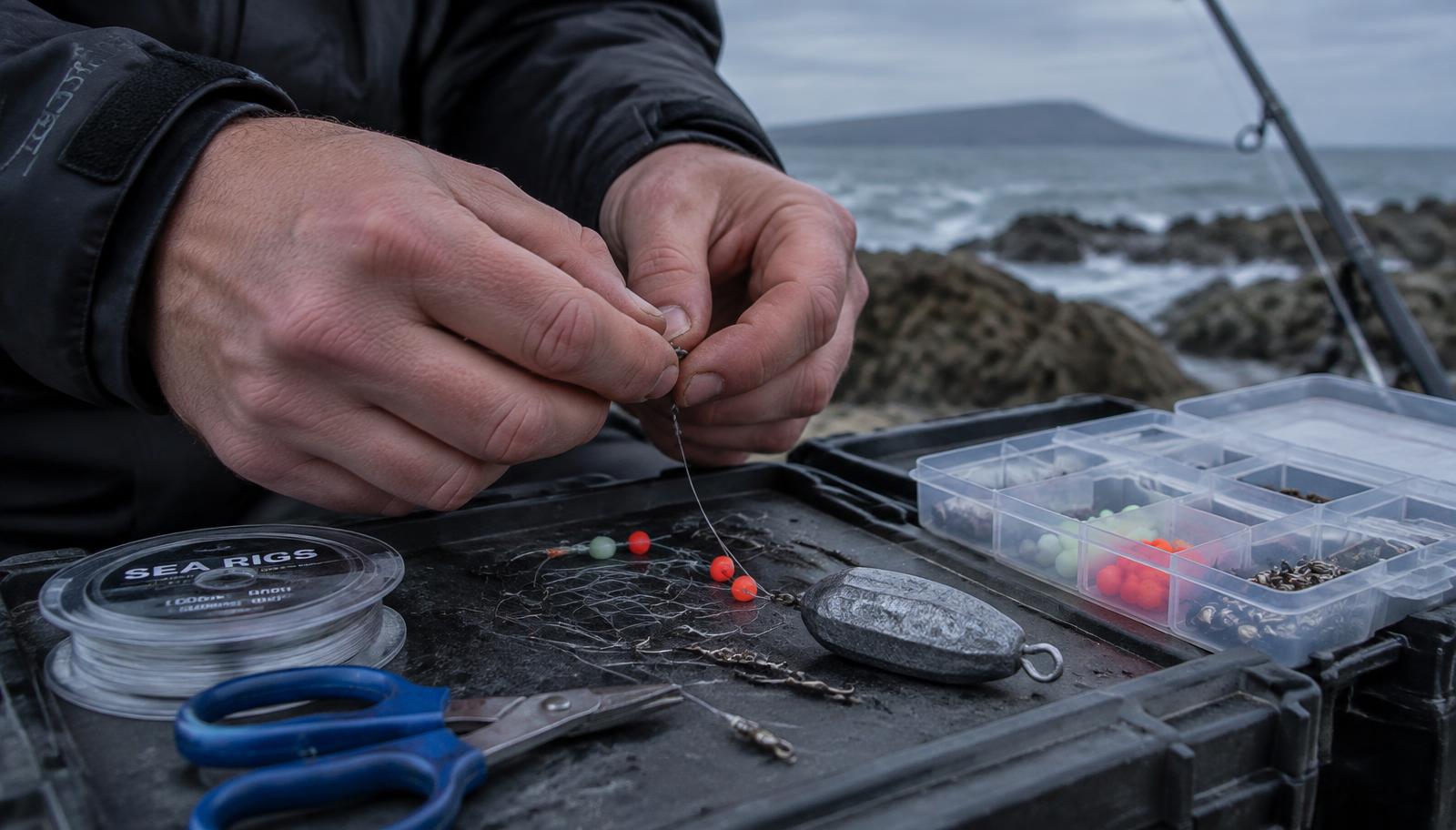
Tying your own rigs is cheaper than buying them, and you can make each one fit the mark, the fish you're after and the conditions on the day. Most Irish shore fishing needs only a few rig types and a small bag of parts. Once you have the basics, tying a rig at home takes about five minutes.
This guide covers the parts you need, the knots worth learning, and step-by-step builds for the rigs that catch most fish around the Irish coast. The line strengths, hook sizes and lengths given are good places to start. Change them to suit your own ground and tackle.
The rig-building kit
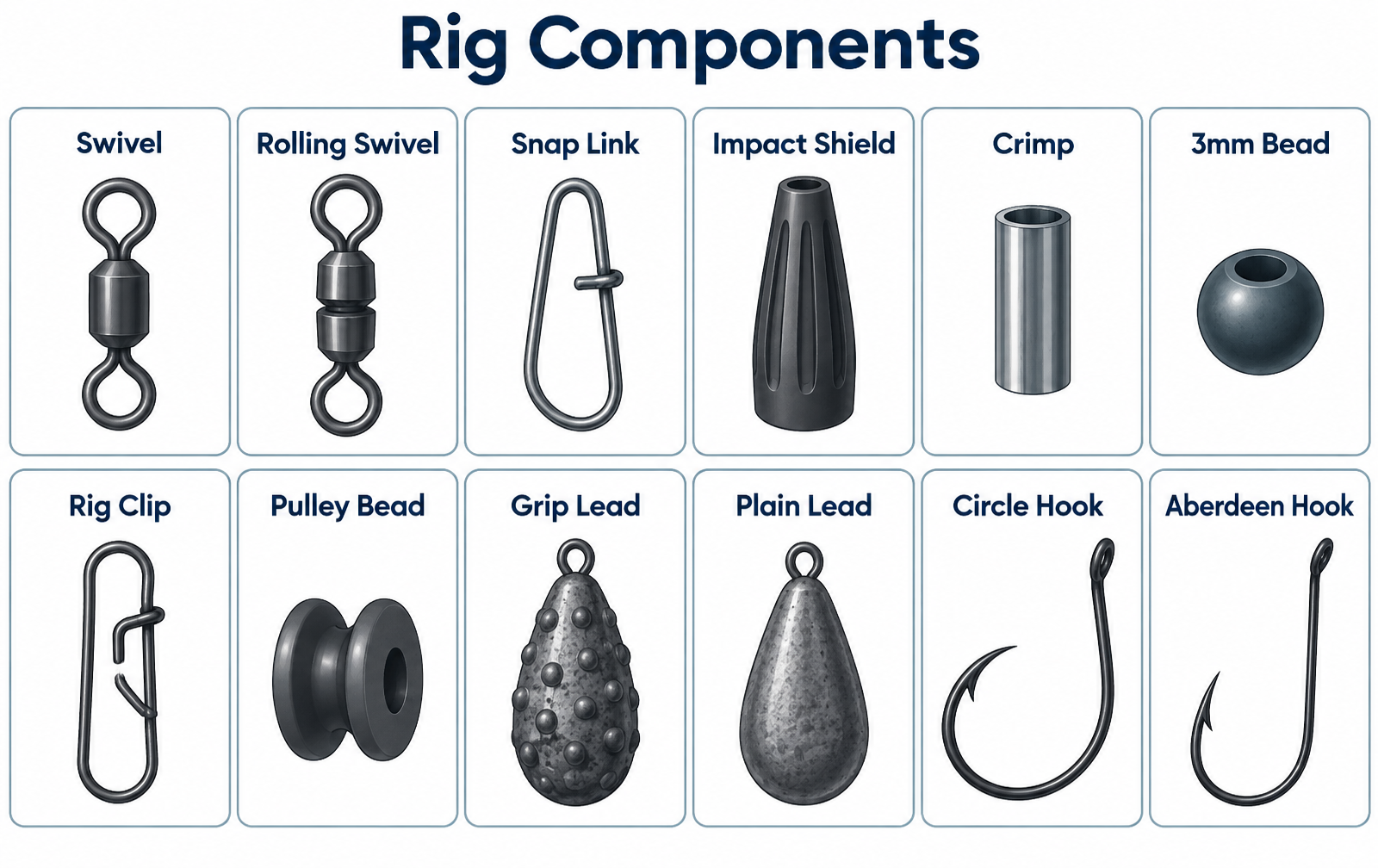
You don't need much to start. A small box with compartments and a rig wallet will hold everything:
- Rig body line: 60–80 lb mono or fluorocarbon. It's stiff, resists tangles and stands up to rubbing on rocks and shingle
- Snood line: 15–30 lb fluorocarbon for most species, up to 40–60 lb for conger and rough ground
- Swivels in sizes 4–10, plus rolling swivels for snoods
- Crimps sized to match your rig body line, and a crimping tool
- 3–5 mm beads, plain or luminous
- Rig clips and impact shields for clipping hooks down when casting
- Pulley beads or pulley swivels
- Hooks: Aberdeens in sizes 2–2/0 for flatfish, whiting and mixed fishing; Vikings or O'Shaughnessy patterns in 1/0–4/0 for bass and bigger baits; circle hooks for catch and release
- Leads: grip leads for holding in tide, plain leads for rolling or rough ground
- Small scissors or braid snips, a lighter for melting mono tag ends, and foam winders to store finished rigs
Knots worth learning
Three or four knots will cover nearly everything:
- Uni knot: strong, easy to tie, and good for hooks and swivels on lighter snoods
- Improved half blood (clinch) knot: fine for hooks on mono up to about 30 lb. Lubricate it and pull it tight slowly
- Palomar knot: very strong for braid and fluorocarbon
- Double grinner or uni-to-uni: joins your main line to a shock leader. Many anglers prefer an Albright or a tapered leader so the knot slides through the rod rings more easily
Always wet a knot before pulling it tight. Friction heat weakens mono and fluorocarbon. Trim the tag end to about 3 mm and test every knot with a hard pull before using it.
Shock leaders: the safety rule
Casting a heavy lead puts a huge load on your line. If light main line breaks during a cast, the lead flies off and can seriously injure someone. The common rule of thumb is 10 lb of leader breaking strain for every ounce of lead. So a 5 oz lead needs a 50 lb leader, and 6 oz needs about 60 lb.
The leader should be long enough to go from the reel, around the spool several times, up through the rod rings, and down to the rig. That's usually about twice the rod length. Never cast a heavy lead on light line, even on a quiet beach.
The 2-hook flapper
This is the most useful general rig for Irish beaches and harbours. It catches whiting, dab, flounder, codling, dogfish and coalfish, and it's the first rig most people should learn.
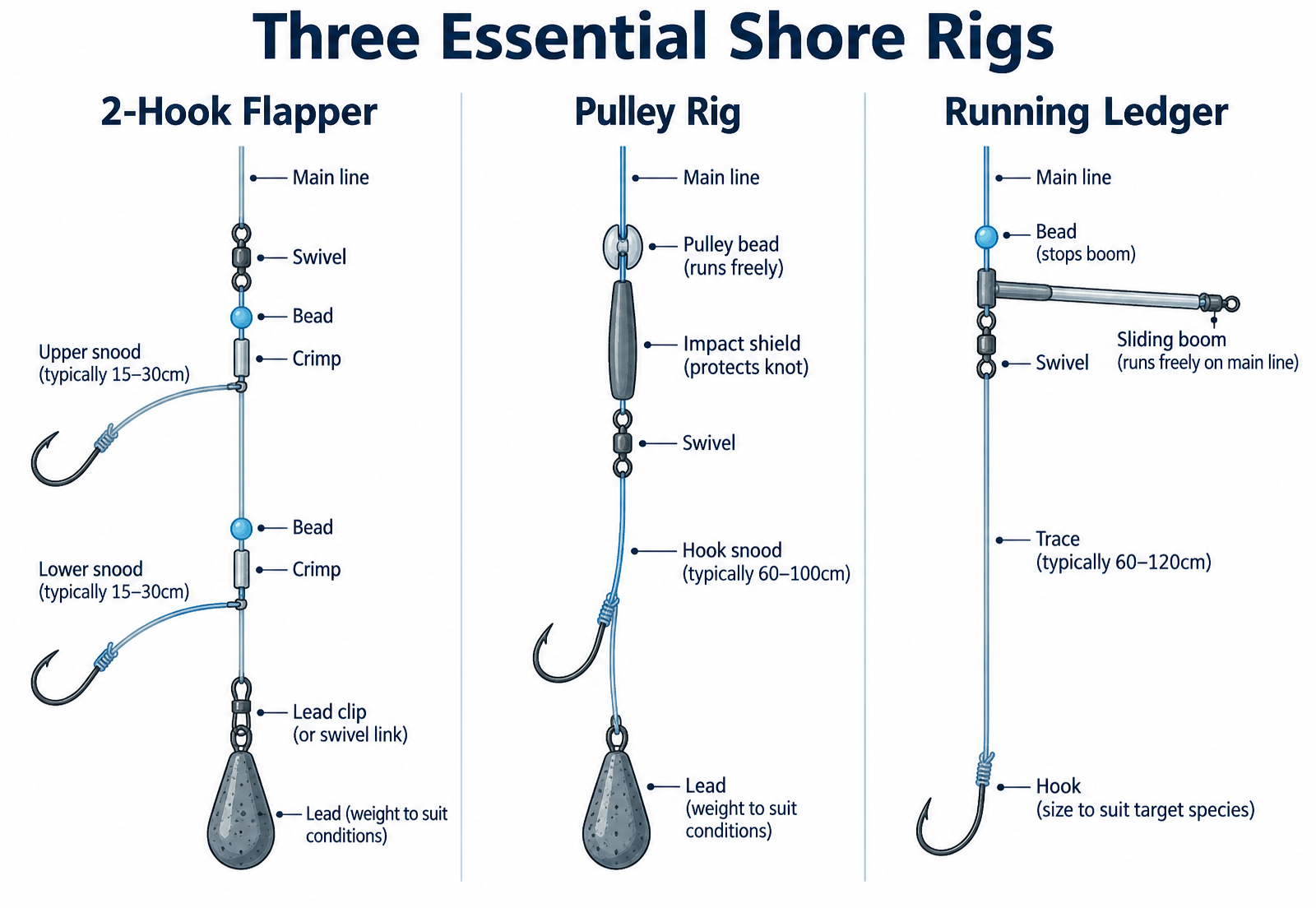
To build it:
- Cut about 1.2 m of 60–80 lb rig body line
- Tie a size 4 swivel to the top
- Thread on a crimp, a bead, a swivel or rolling swivel for the top snood, then another bead and crimp
- Repeat for the second snood about 40–50 cm lower
- Tie a lead clip or snap link to the bottom
- Slide the snood points to where you want them and crimp them in place. Don't crush the crimps too hard, or they'll cut the line
- Tie 15–30 cm snoods of 20–25 lb fluorocarbon to the snood swivels, with size 1 or 1/0 Aberdeens
Keep the bottom snood short enough that it can't tangle with the lead. Flappers don't cast far, so use them on marks where the fish are in close.
The clipped-down 2-hook rig
This is the same as the flapper, but each hook is clipped to a rig clip or impact shield lower down. The baits are held tight against the rig body while casting, so they fly better and stay on the hook. When the lead hits the water, the hooks release.
Use this rig on beaches where you need distance, such as long, shallow strands where the fish feed further out. Short snoods of 50–70 cm work best, and the hook should sit on the clip with a little tension.
The pulley rig
The pulley rig is the main rig for rough ground and the best all-round rig for bass and bigger fish. When a fish bites, the lead is pulled up close to the hook, so the weight is lifted out of snags as you reel in. It's also hard for a fish to drop off.
To build it:
- Thread a pulley bead or pulley swivel onto 80 lb rig body line
- Tie a lead link to one end
- Thread on a bead and an impact shield on the hook side, then tie on a swivel
- Tie a 60–100 cm snood of 30–60 lb line to the swivel, with a 3/0–6/0 hook
- To cast it, clip the hook into the impact shield, which sits just under the lead
Bait it with a big crab, a mackerel flapper, or a big lugworm bait for bass, ray, conger or codling. On rough ground, use a weak link to the lead (for example 15–20 lb line) so you only lose the lead if it snags.
The running ledger
This is the simplest rig there is, and very good for bass in calm water, mullet on bread, and big wary fish. The fish can take the bait and swim off without feeling the weight of the lead.
- Slide a running boom or zip slider onto your main line or leader
- Add a bead to protect the knot
- Tie on a swivel
- Tie 60–120 cm of trace to the swivel, with your hook
This rig is great for estuaries, harbours and calm bays in summer. It casts badly in a strong wind, so keep it for fishing at closer range.
The pennel rig
A pennel rig uses two hooks on one snood to hold big baits, like a whole squid, a mackerel fillet, or a large lug and squid cocktail. One hook sits at the head of the bait and the other at the base, so you can hook fish that take the bait from either end.
- Thread the top hook onto the snood first
- Tie the bottom hook to the end of the snood
- Slide the top hook up to where it fits the bait, and hold it in place with a short piece of silicone tube or a few turns of line wrapped round the shank
Use 3/0–4/0 hooks for bass and ray, or 4/0–6/0 for conger, with a heavier snood.
The float rig
Float fishing from rocks, piers and harbour walls is a great way to catch pollock, wrasse, mackerel, garfish and mullet. It also keeps your bait away from snags.
- Tie a sliding stop knot (or a rubber float stop) on the main line at your depth
- Add a bead, then a sliding float
- Add a small drilled bullet or barrel lead to cock the float
- Tie on a swivel, then 1–1.5 m of 10–15 lb fluorocarbon with a size 4–1/0 hook
Set the depth so the bait sits just above the weed. For wrasse, try about 3–5 m off the rocks. For mackerel and garfish, fish shallower. Pollock often feed at the edge of the kelp.
Feathers and sabikis
Strings of feathers or small sabiki lures are the quickest way to catch mackerel for bait in summer, and they also catch pollock, coalfish and launce. You can buy them, but they're easy to make with small flashy lures on short droppers.
Only use as many hooks as you need. Six hooks are more likely to tangle, and many clubs and competitions set limits. Release small fish quickly and only keep what you'll use.
Lure rigs for bass and pollock
Bass and pollock fishing with lures is very popular around Ireland. For most lure fishing, tie a 1–2 m fluorocarbon leader of 15–25 lb to your braid using an FG knot or a double uni. Then clip on the lure with a small, strong snap so you can change lures quickly.
For soft plastics, use a weedless hook on a weighted jig head or a texas rig. A free-running bullet weight above a bead and the hook lets you work the bait slowly over the weed.
Hooks for each species
These are good starting sizes for Irish species:
- Dab, flounder and plaice: size 2–1 Aberdeens, long shank
- Whiting: size 1–1/0 Aberdeens
- Codling: 1/0–3/0
- Bass: 1/0–4/0 Vikings or circle hooks, depending on bait size
- Thornback and other rays: 2/0–4/0, usually on a pulley or pennel
- Dogfish and huss: 1/0–3/0, strong pattern
- Conger: 4/0–8/0 heavy pattern on a heavy snood or wire
- Wrasse: size 2–1/0 strong hooks on float or short-snood rigs
- Mullet: size 6–10 for bread and small baits
Choosing the right rig
- Clean sandy beaches, small fish close in: 2-hook flapper
- Long beaches where the fish are far out: clipped-down 2-hook
- Rough ground, rocks and big fish: pulley rig with a weak link
- Calm estuaries, harbours, and wary bass and mullet: running ledger
- Big baits: pennel
- Rock marks and kelp edges: float rig or lure fishing
Storing your rigs
Wind finished rigs onto foam or plastic winders, and label each one with the rig type and hook size. Rig wallets keep them flat, tidy and easy to find. After each trip, rinse your used rigs in fresh water. Bin any that have crushed snoods, rusty hooks or worn crimps. A rig that has been rubbed on rocks will be much weaker than new, so it's not worth the risk.
Common mistakes
- Using too light a shock leader for the lead you're casting
- Crushing crimps until they cut into the line
- Not wetting knots before pulling them tight
- Making snoods so long they tangle with each other or the lead
- Using hooks that are too big for the species and bait
- Fishing rough ground without a weak link, and losing whole rigs
- Not checking snoods for damage between casts
Final tips
Start with just a flapper and a pulley rig, and tie a few of each before you go. Once you've learned how they behave on your local marks, it's easy to make small changes like snood length, hook size or line strength. Keep notes in your fishing log of which rigs caught on which marks. Over time, it will become a very useful record.
Comments
Sign in to join the conversation.